What are biosolids? Is Loop® the same thing?
Biosolids are the fertilizing and soil building products created by wastewater facilities around the world. Wastewater facilities can do more than just clean the water, they can also turn the valuable resources in the water into useful products like biosolids, biogas (renewable energy) and recycled water. This is what King County does. King County’s biosolids are called Loop®, and Loop is rich in essential nutrients and organic matter that plants love.
How is Loop made?
All the water that comes to the plant from homes and business is first separated into “solid” and “liquid” streams using gravity. Then, the “liquid” (the water) goes to its own part of the plant to be cleaned and to be turned into recycled water for things like irrigation and street cleaning. The “solids” (essentially the poop and the food) are put into a big heated tank called an anaerobic digester. In the digester, beneficial microorganisms, the same ones that live in our own stomachs and digestive system, break down the material until it is biologically transformed, all while creating biogas (renewable energy). When this process is complete, extra water is removed, leaving a fertilizer and soil builder that is full of the essential nutrients and organic matter.
Are biosolids the same as "sewage sludge" or “raw sewage”?
No. No more than bread dough is the same as a loaf of bread. Biosolids are the end-result of regulated treatment processes, such as anaerobic digestion at warm temperatures. Anaerobic digestion uses big, heated tanks. Just like your stomach, microorganisms break down the poop and the food, leaving organic matter and nutrients. The solids that are separated and cleaned only become biosolids after treatment is complete.
What does Loop look like?
Loop looks like black mud. It’s somewhat crumbly but also sort of spongy, much like Play-Doh. Sometimes Loop sparkles with struvite, a beneficial phosphorus and nitrogen-rich mineral.
Loop on its own looks a lot like worm castings, has an earthy smell, and is available to commercial customers. It is usually put on crops using a manure spreader or similar equipment.
What does Loop smell like?
Freshly applied Loop can have an odor, usually described as “earthy” or “organic,” similar in some respects to bone meal or manure; people often describe a hint of “ammonia” to the odor as well. After being worked into the soil the odor typically goes away within a short time.
Compost or soil mixes that contain biosolids have much less odor — usually quite similar to potting soil or any other organic mulch. People often describe compost made with biosolids as having an earthy aroma, similar to a forest floor.
Where can I get Loop?
Only commercial farms and forests permitted for biosolids land application can use Loop, King County Biosolids. Commercial growers in Douglas or Yakima counties can contact Boulder Park Inc. or Natural Selection Farms respectively.
Please email loop@kingcounty.gov to inquire about using Loop for your farm or forest operations.
Loop can be used to grow some types of food, like wheat or canola. Certain crops have waiting times before harvest, so the environment has enough time to do its job and kill any lingering pathogens. Because Loop is rich in organic matter and slow-release nutrients, one application provides benefits for years. Loop is applied precisely according to decades of research and best management practices. Studies have found that food grown with biosolids has higher protein content than food grown with commercial fertilizer.
Visit the Who Uses Loop page for more information on these customers, and read their stories.
What else could King County do with Loop?
New innovative technologies are continually reviewed and pilot tested by our technology assessment team and university researchers, because we want to be the leader in our field. But it turns out, what we’ve been doing for decades is still pretty innovative and cost effective for our ratepayers. Not only do we harness renewable energy to power our treatment plants, but using Loop on farms, forests and gardens recycles nutrients, makes plants thrive, and helps us grow food for sustainable communities. Loop even helps us fight climate change.
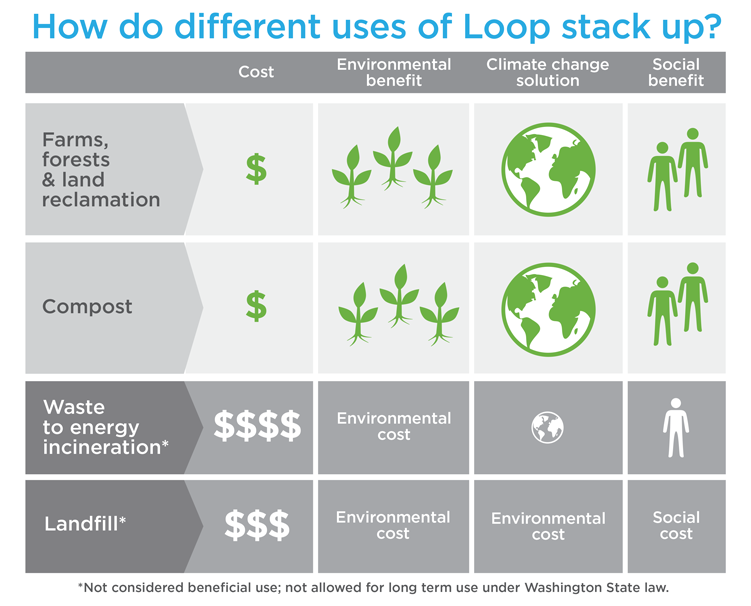
Because the benefits and safety of using biosolids has been demonstrated for decades, Washington State Department of Ecology mandates that biosolids are used as a soil builder and fertilizer, conserving landfill space for waste materials. If we tried to burn Loop, it would create air pollution and would take a lot of energy because Loop is mostly water.
If we didn’t use Loop on farms, forests and gardens, we would waste all these benefits. Check out how different uses of Loop stack up in the diagram below.
What are the long-term effects of using Loop on farms and forests?
Loop has been used as a fertilizer replacement and soil builder for decades, with a long list of happy customers. The long-term effects of Loop are healthy, fertile soil. Loop improves soil fertility and supports healthy plants. Long-term (20+ years), peer reviewed, academic studies show significant increases in soil organic matter and improved soil structure, both measures of healthy soil.
Is using biosolids safe?
Loop is very similar to any other natural fertilizer or soil builder, such as manure. King County has been using Loop on our customer’s farms, forests and landscapes for more than 40 years. Visit the Quality and Testing page for more information.
What can I do to protect the quality of Loop?
The best way to protect the quality of Loop is to prevent putting certain waste down the drain. The following items should go in the trash, not in the toilet or the sink:
- Stickers from fruits or vegetables
- Plastic and other non-organic materials like condoms or tampons
- Expired/unwanted prescription or over-the-counter drugs.
- Grease and other fat from the kitchen
- Disposable wipes, diapers, and liners, even if they are labelled as “flushable”
- Products labeled “danger”, “hazardous” or “toxic”
Try to use fewer cleaning products and chemicals at home and switch to “biodegradable” or more natural alternatives.
Remember: Don’t flush trouble! Only toilet paper and human waste should get flushed.
Are there toxic substances in Loop?
Only because there are toxic substances everywhere, from households to the arctic. Using biosolids like Loop is a great way to return organic matter and essential nutrients back to the land, and it makes growing food more sustainable. For a gardener, it would take 77,266 years of using biosolids before you would get one dose of ibuprofen. We’re not planning to live that long!
Visit the Loop Quality and Testing page for detailed information on how we protect Loop’s product quality.
Are there disease-causing organisms (pathogens) in Loop?
Not for long! Almost all the pathogens (95-99%) are eliminated in the cleaning process when we make Loop. The rest die quickly from sunlight, heat, and competing soil microorganisms. Biosolids are managed to keep people and the world we live in safe. The average person will never come into direct contact with Loop, and certain crops have waiting times before harvest, so the environment has enough time to do its job and kill any lingering pathogens. Our operators at the treatment plants and our customers work with Loop every single day – and they are happy and healthy!
Processes like composting kill the remaining pathogens, so products like compost made with Loop can be used by anyone on everything from veggie gardens to landscapes to farms.
Visit the Quality and Testing page to find out more.
Does using Loop affect surface or ground water?
No. Decades of research, testing, and monitoring have shown that Loop is a benefit to the environment and our water bodies. Loop is applied at what’s called an agronomic rate. An agronomic rate means that we apply the exact amount of nutrients the plant needs. Loop is rich in organic matter and nutrients that are released slowly as plants need them, which means Loop’s nutrients stay tightly bound in the soil for plants and away from water bodies. Since what is good for the soil and plants is not always good for the water, Loop is never applied directly next to streams, wetlands, or other water bodies.
Visit the Quality and Testing and What is Loop? pages for more information.
Where can I get more information about the King County Biosolids Program?
Visit the King County’s Biosolids Program page for more information.