Loop® compost is Here
Loop® Compost offers a rich, stable, and odor-free blend of nutrients ideal for flowers, vegetable gardens, and landscaping. And it comes from right here in the community—made locally by our team and put to work by you.
If you are a non-profit or community garden interested in Loop Compost, please reach out using the Contact Page or email us at loop@kingcounty.gov.
Stay tuned for news as we finalize the details of making this new compost product available to the community.

Why we love Loop compost
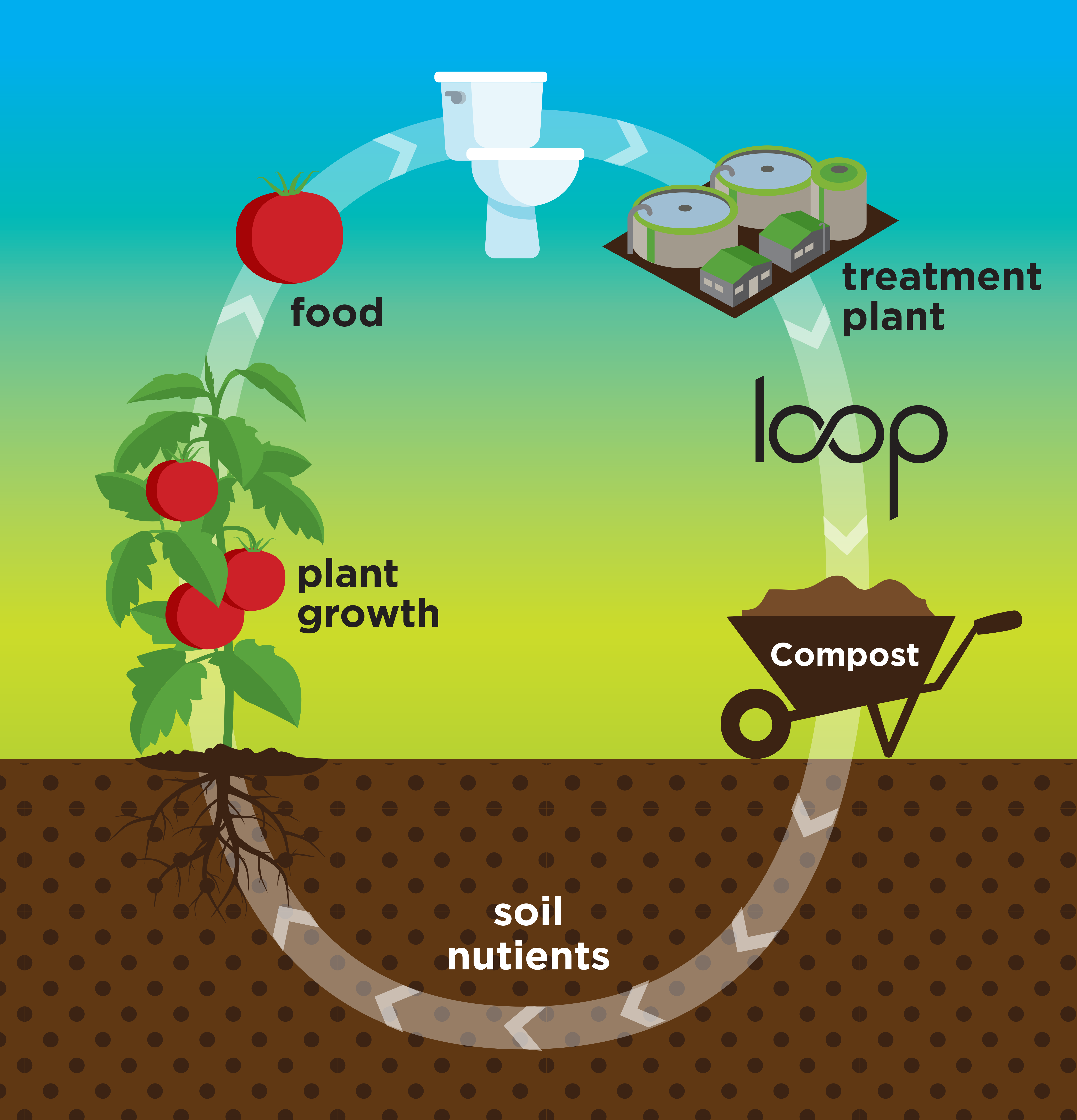
Loop Compost starts with something wonderfully simple: everything that goes down our toilets and drains gets treated, recycled, and transformed into a nutrient rich compost. By returning those nutrients to the land, we cut down on waste and help our gardens, parks, and farms thrive. It’s a feel-good, do-good way to take care of the place we call home.
Gardeners and landscapers love Loop Compost because it brings tired soils back to life. It adds organic matter, improves the structure of both sandy and clay soils, boosts aeration, and helps the ground hold onto moisture—so plants grow stronger, greener, and more vibrant. And there’s a bonus: healthier soils act like natural sponges, soaking up rainwater and reducing the amount of polluted stormwater that flows into Puget Sound.
Adding organic material like Loop Compost strengthens soil from the inside out, improving its biological, physical, and chemical health. And while any compost can help over time, Loop Compost stands out. It’s a high quality, rigorously tested product packed with the full suite of macro and micronutrients that plants need, plus the unique benefits that come from the Loop process.
Left: Beets grown with a local organic compost.
Right: Beets grown with compost made with Loop.
How to use Loop compost
Loop Compost can be used for flowers, annual crops, lawns, perennials, and even indoor plants. Add it to the soil for lush plant growth.
- For annual flower and vegetable beds add 1-3” to the top of your garden soil and till it in 6-12” deep each spring.
- For turf add 1/4-1/2″ and rake evenly across the grass once a year.
- For perennial shrubs and trees, add 1-3” to the soil surface. As with any compost product or bark mulch, be sure to leave a 3” border around plant stems and trunks.
- Freshen up indoor plants by sprinkling a 1/4-2” of compost to the surface of the pot.
By using Loop Compost, we waste less– and grow more life in the soil, right here in our region.
How Loop compost is made
Loop Compost is a high-quality compost made locally from organic matter collected through our region’s wastewater treatment process. You flush, we transform!
To create Loop Compost, we mix 1-part biosolids with 3-parts woody material. Also, to make Loop Compost even more environmentally friendly, we use clean wood material that otherwise may have gone to waste.
The mixture is formed into large, airy piles that sit on top of pipes blowing gentle streams of air to keep everything well aerated. The piles are turned regularly so the compost breaks down evenly. Throughout the process, we closely monitor temperatures – along with routine lab testing – to make sure the heat stays high enough to eliminate harmful organisms and meet EPA standards for safety. Once the high heat phase is complete and all pathogens have been destroyed, the compost is left to rest and cure, developing into a stable, finished product ready for gardens and landscapes.
Loop Compost is rigorously tested and meets Class A standards, meaning it’s pathogen free and approved for use in your garden. Loop Compost is comprehensively tested for quality to ensure a stable and mature product for a variety of residential growing applications.
All the nutrients found in Loop are also found in Loop Compost, although at lower concentrations because of the blending with woody material. Instead of sending these nutrients to landfills, we return them to the soil, where they help plants and ecosystems thrive.
Compost FAQs
How is Loop Compost Different from Loop?
Loop Compost and Loop Biosolids are closely related, but they’re not the same product, and the differences come down to how they’re made, how concentrated they are, and how they’re used. Loop Biosolids are the nutrient-rich material created after wastewater is treated and cleaned. They’re packed with all the macro and micronutrients plants need, and they’re used directly to build healthy soils on farms and forests. Because they’re not blended with anything else, the nutrients present at full strength.
Loop Compost is made by mixing 1 part Loop Biosolids with 3 parts woody material – clean wood that might otherwise have gone to waste. This blend creates a lighter, more soil-like product that’s easy to use in gardens, landscaping, and community spaces.
During the composting process, the mixture heats up naturally. Those high temperatures are carefully monitored to ensure all pathogens are destroyed, making Loop Compost safe and ready for home and community use.
Loop® biosolids are only available to commercial farms and forests permitted for biosolids land application. To learn more, check out our Who Uses Loop page or the Loop FAQ page.
Where can I get Loop Compost?
We are currently distributing Loop Compost on a limited basis. If you are a non-profit or community garden interested in Loop Compost, please reach out via the Contact page or email loop@kingcounty.gov.
What was GroCo and how was it produced?
First introduced in 1976, GroCo compost was a natural, soil building blend made from two simple ingredients: sawdust and nutrient rich Loop biosolids. That combination created a compost with a full suite of plant ready nutrients, and it enriched gardens, farms, and landscapes across the region for decades.
GroCo existed thanks to a longstanding partnership between King County and a private composter. Each year, a small portion of Loop was sent to GroCo Inc. and Sawdust Supply, where it was transformed into the compost gardeners came to rely on. For almost 50 years, this partnership kept valuable materials in circulation and helped build healthier soils throughout the region.
In 2020, GroCo Inc. and Sawdust Supply closed their business, bringing the GroCo era to an end. But the story didn’t stop there. In 2025, King County began producing Loop Compost – made with the same core ingredients and the same commitment to soil health and sustainability that defined GroCo for generations.
Loop Compost carries forward the legacy of GroCo, offering a modern, thoughtfully made compost that continues to nourish the land and support the communities that depend on it.
To learn more, watch our YouTube video What is GroCo compost?
What is Loop Compost used for?
You can use Loop Compost in your garden, lawn, landscape, and indoor plants!
- For annual flower and vegetable beds add 1-3” to the top of your garden soil and till it in 6-12” deep each spring.
- For turf add 1/4-1/2” and rake evenly across the grass once a year.
- For perennial shrubs and trees, add 1-3” to the soil surface. As with any compost product or bark mulch, be sure to leave a 3” border around plant stems and trunks.
- Freshen up indoor plants by sprinkling a 1/4-2” of compost to the surface of the pot.
Why is King County making Loop Compost?
For decades, biosolids-based products have supported local farms, forests, and landscapes, and this project continues that legacy by creating a reliable, high-quality compost that can be used close to home. Producing Loop Compost locally also ensures a steady supply of a Class A biosolids product that supports soil health while keeping valuable nutrients in circulation.
King County launched a pilot composting project at the South Treatment Plant in 2025 to expand the beneficial reuse of Loop biosolids right here in the region. The facility produces about 35 cubic yards of compost each week—roughly 1,500 cubic yards a year—creating a meaningful new source of sustainable, soil building material for the community.
Loop Compost represents a thoughtful next step in King County’s long history of turning local resources into healthier soils, cleaner waterways, and stronger communities.
Can I use Loop Compost on my garden with confidence?
Loop biosolids are regulated more stringently than any other soil amendment, manure, compost, or fertilizer on the market. To learn more about our rigorous testing and research visit our Quality and Testing page and our Leading with Science page.
Loop Compost consistently meets the highest standards set by the US EPA and the Washington Department of Ecology. Loop Compost meets the regulatory requirements for metals for Class A, Exceptional quality biosolids (WAC 173-308 Table 3) and pathogen reduction from composting as a process to further reduce pathogens under WAC 173-308-170 (3)(b).
Rigorously tested and regularly monitored, Loop is checked for safety and effectiveness by the EPA, the State of Washington, and backed by decades of university research.
What is the quality of Loop Compost?
In addition to being pathogen free and designated Exceptional Quality Biosolids by Washington Department of Ecology, we test frequently for metals, pathogens, and comprehensive compost parameters like nutrients and compost stability/maturity. We send our compost to an approved Seal of Testing Assurance laboratory by the US Composting Council for testing which ensures reliable, accurate compost-specific analytical data.
From our test results we know our compost has the following high-quality characteristics:
- Fully matured compost is stable, well‑finished material that supports seed germination and healthy plant growth. Loop Compost has fully completed the decomposition process which ensures that it enhances soils without releasing compounds that could hinder seedling establishment or plant vigor.
- Full suite of macro- and micro- nutrient content
- All the essential nutrients for lush plant growth and healthy soil
Please use the Contact page if you would like to request to receive a copy of the compost analysis results.
What is the nutrient value of Loop Compost?
The nutrients found in Loop are also found in compost made with Loop biosolids. It contains both macro- and micro- nutrients beneficial for plant growth.
You do not need to add fertilizer to Loop Compost!
Loop Compost has an average pH around 6.3 between (5.5 – 7) and typically contains 3.1% N (total nitrogen), 3.6% P (as P2O5), and 0.4% K (as K2O) on a dry weight basis.
Compost increases soil organic matter which releases nitrogen slowly over time. In years 2 and 3, after an initial year 1 application you can expect organic nitrogen to become available to plants. Take into consideration that after multiple years of applications you won’t need to apply as much compost as you did before to meet plant nutrient needs.
Take the guessing out of your soil testing!
If you are in King County, check out King Conservation District’s (KCD’s) resources on Soil Nutrient Testing Program. For any garden, we recommend soil testing and matching the needs of your planned crop. Check if you are eligible on KCD’s Healthy Soil webpage.
How does Loop Compost compare to other compost?
Loop Compost is likely the most highly regulated compost that exists on the market due to its being made with biosolids.
Loop Compost is special because it has the following characteristics:
- Locally sourced, transformed, and applied.
- Loop is endlessly renewable resource supplied by you and transformed by us. We give it back as Loop Compost, made with Loop biosolids; we call this the “Poop Loop”.
- Low contamination of inert (non-decomposable) materials.
- No undecomposed “compostable” forks in here!
- Destruction of weed seeds.
- We aerate our compost and carefully control the process to temperatures which consistently destroy weed seeds.
- Gives a nutrient boost.
- Our compost is slightly more than 3% total nitrogen which means nitrogen won’t be bound up in the soil and is released slowly over time, this builds soil and provides available nitrogen for plants over time.
- The final compost Carbon to Nitrogen ratio is between 10 to 12, which means compost can provide nitrogen and build the soil too!
What are biosolids products and what impact do they have on the urban environment?
Biosolids products are common in the U.S. and well-loved in the region. The former GroCo compost, made with Loop biosolids, enriched Pacific Northwest landscapes from 1976 to 2020. In addition, our neighboring city of Tacoma also produces an excellent biosolids product. Learn more about TAGRO soil blends. You can also view a list of regional cities that have biosolids products for home gardeners at Northwest Biosolids.
Decades of research show that biosolid-based products have the following benefits to our urban environment:
- Provide essential plant nutrients
- Improve soil structure and tilth
- Increase soil organic matter
- Enhance soil water holding capacity and soil water infiltration, reducing dirty stormwater runoff
- Reduce soil erosion